

4 años
Septiembre 2027
Presencial
240 (60/año)
Español
60 plazas
Bachelor’s Degree in Nursing
Déjanos tu datos y te contactaremos
Programme Objectives
The Bachelor’s Degree in Nursing at UNINDE trains professionals to provide comprehensive healthcare, applying both scientific knowledge and practical skills. Throughout the programme, you will develop the skills needed to work independently or as part of a team, with a strong emphasis on ethical responsibility, quality of care and respect for patients’ rights.
Technical and Professional Healthcare
Provide technical and professional healthcare in accordance with current legal and professional ethical standards.
Promoting Healthy Lifestyles and Self-Care
Promote healthy lifestyles and self-care among patients, helping to prevent illnesses and complications.
Planning and Delivering Nursing Care
Plan and deliver nursing care for individuals, families and groups, evaluating its impact on their health.
Delivering Evidence-Based Interventions
Deliver evidence-based interventions using available resources to ensure patient safety.
Understanding and Applying Theoretical Principles
Understand and apply the theoretical and methodological principles of nursing in real-world situations.
Working Effectively in Multidisciplinary Teams
Work effectively in multidisciplinary teams, ensuring continuity of care and a comprehensive approach to patient care.
Working with Respect for Diversity
Work with respect for cultural diversity, promoting patients’ participation, autonomy and informed consent.
Teaching Methodology and Student Support
Lectures, specialised laboratories, clinical simulation and guaranteed placements in professional healthcare settings.
Development of technical knowledge, clinical skills, professional ethics, effective communication and collaborative working.
Ongoing assessment of learning progress through practical and theoretical examinations, applied projects and the Final Degree Project.
Academic tutorials, professional mentoring and personalised support throughout the entire programme.
Virtual campus, advanced digital environments, up-to-date bibliographic resources and professional simulation tools.
Integrating technological innovation with ethical awareness and social commitment, in line with UNINDE’s core values.
ACADEMIC STRUCTURE
Study Plan
The Study Plan for UNINDE’s Bachelor’s Degree in Nursing is designed to provide you with a comprehensive education. Over the four years, you will combine theoretical knowledge, real clinical placements and professional experience, preparing you to become a highly qualified nurse with technical, ethical and interpersonal skills in healthcare.
Basic Training
Core subjects in health sciences, including anatomy, physiology, biochemistry, psychology and public health, which provide the scientific foundation for the degree.
Compulsory Nursing Subjects
Clinical and healthcare subjects, including primary care, mental health, specialised care, professional ethics and healthcare management.
Clinical Placements
Practical training in real healthcare settings, with direct contact with patients and healthcare professionals.
Elective Subjects
Subjects designed to support specialisation and tailor your learning pathway.
Final Degree Project
An integrative project that consolidates the skills and competencies acquired throughout the degree.
PROFESSIONAL FUTURE
Career Opportunities and Employability
Nursing graduates have the training required to work independently or as part of multidisciplinary teams in hospitals, clinics, health centres and other public and private healthcare settings, providing care at every stage of life.

Professional practice in hospital settings, in both the public and private sectors.

Direct involvement in health centres, preventive care programmes and community healthcare.

Working in emergency services, intensive care units (ICUs) and highly specialised care units.

Specialist care in geriatrics, paediatrics, palliative care and mental health.

Professional development in biomedical research, public health and academic teaching.

Team leadership, healthcare facility administration and management of care processes.
PROFESSIONAL CAREER
Work Placements in Companies
Clinical placements are a fundamental part of UNINDE’s Bachelor’s Degree in Nursing, enabling students to gain hands-on experience in the professional field. Through partnerships with hospitals, health centres and other prestigious institutions, our students have the opportunity to put what they have learned into practice in real-life situations, developing their skills and competencies in a professional environment.

Admissions
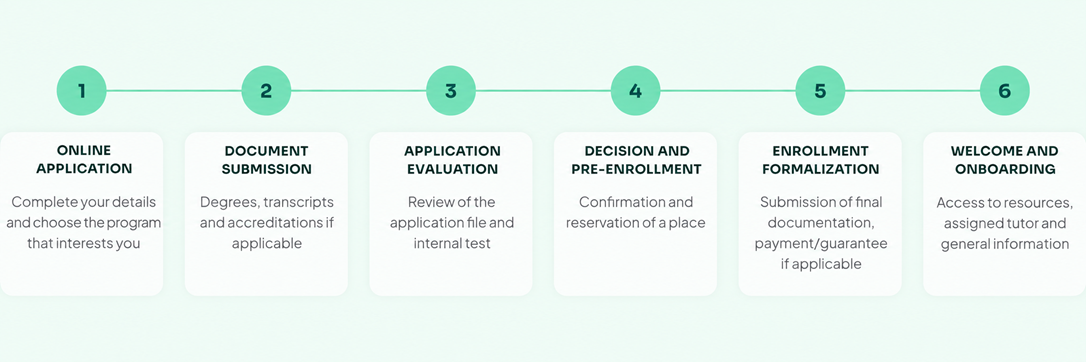
Admissions Process
Complete your enrolment quickly and easily. Follow these steps to secure your place and begin your studies on the Bachelor’s Degree in Nursing, with everything you need to access the resources and tools from day one.
Entry Requirements and Required Documentation
To gain admission to the Bachelor’s Degree in Nursing, students must meet the requirements established by current regulations and submit the necessary documentation. The entry requirements for each admission route are outlined below:
Valid Academic Entry Qualification
A Bachillerato qualification, an Advanced Vocational Training qualification or another officially recognised qualification granting access to university.
Official Academic Transcript
A full academic transcript detailing the subjects studied, the grades obtained and successful completion of previous studies.
Proof of Identity
A valid national identity card (DNI) or passport and, where applicable, an official recognition decision or certified translation of foreign qualifications.
Proof of Language Proficiency
A recognised certificate demonstrating the required level of language proficiency, where this is a specific requirement of the degree programme.
Additional Documentation
Additional requirements arising from agreements, work placements, mobility programmes or other specific academic circumstances.
Supporting Documentation
The university may request additional information depending on the applicant’s profile or specific academic circumstances.
Regulations and Accreditations
The Bachelor’s Degree in Nursing is governed by the current regulations applicable to official university programmes in Spain, as well as by the requirements that ensure academic quality, scientific rigour and official recognition.
The organisation, verification and accreditation of official degree programmes comply with the requirements established by Royal Decree 822/2021, which regulates the organisation of official university education and quality assurance.
Furthermore, official degrees qualifying graduates to practise as registered nurses are verified in accordance with Ministerial Order CIN/2134/2008, which establishes the requirements for the accreditation of these degrees, recognised throughout Spain.
Official Links
Would you like to know more?
Download the Full Study Plan
Access detailed information on modules, competencies, ECTS credits and the year-by-year structure of UNINDE’s Bachelor’s Degree in Nursing. This study plan will help you understand what you will study at each stage of the programme and how theoretical and practical learning are integrated.
Contact the Student Guidance Team
Do you have any questions about admission, enrolment, placements or career opportunities for the Bachelor’s Degree in Nursing? Our Student Guidance Team is here to answer your questions, explain the application process and help you prepare your application. Get in touch and we’ll be happy to assist you.
FAQs
We’ve gathered the answers to the most frequently asked questions about UNINDE here, so you can quickly and easily find the information you need.
If you can’t find the answer to your question or need further details, our team will be happy to help. Simply get in touch and we’ll get back to you as soon as possible.
How long is the Bachelor’s Degree in Nursing at UNINDE, and how many ECTS credits does it comprise?
The Bachelor’s Degree in Nursing at UNINDE lasts 4 years and comprises 240 ECTS credits, combining theoretical training with clinical placements in real healthcare settings from the first years of the programme.
What are the entry requirements for the Bachelor’s Degree in Nursing at UNINDE?
To apply, you must hold a qualification that grants access to university, such as the Spanish Bachillerato, an Advanced Vocational Training qualification, previous university studies or officially recognised foreign qualifications. You must also submit the required documentation in accordance with current regulations.
What language is the Bachelor’s Degree in Nursing taught in?
The programme is taught primarily in Spanish, so an adequate level of proficiency in the language is recommended to follow lectures and communicate effectively with patients during clinical placements.
What types of clinical placements are included in the programme?
The study plan includes supervised clinical placements in hospitals, healthcare centres and other real-world healthcare settings, allowing you to put your knowledge into practice and work alongside multidisciplinary healthcare teams.
What career opportunities are available with a Nursing degree?
Graduates can pursue careers in public and private hospitals, primary care, emergency services, mental health, community healthcare, palliative care, healthcare management, research and teaching, among other areas of healthcare.
Can I work while studying for a Nursing degree?
Yes. In Spain, international students holding a student visa are allowed to work up to 30 hours per week, provided that their employment does not interfere with their studies.
What sets studying Nursing at UNINDE apart?
At UNINDE, you will benefit from a combination of solid academic training, clinical placements from the very beginning of the programme and personalised support, with a focus on developing the practical skills and competencies needed to succeed in the healthcare sector.
Can I have my qualification officially recognised if I come from abroad?
If you completed your previous studies outside Spain, you will generally need to obtain official recognition of your qualification and, where applicable, demonstrate a minimum level of language proficiency to gain admission to the degree programme.