

Bachelor’s Degree in Computer Engineering
Déjanos tu datos y te contactaremos
4 years
September 2027
Presencial
240 (60/year)
Spanish
40 places
Programme Objectives
UNINDE’s Bachelor’s Degree in Computer Engineering provides theoretical and practical training in computer systems development, cybersecurity and data analytics.
Over the four-year programme, students will develop skills in systems design, programming, network management, data protection and the processing of large volumes of information. They will learn to work both independently and as part of multidisciplinary teams.
Through work placements with companies in the technology sector, the programme provides comprehensive, practical training aligned with the current needs of the technology industry.
Acquire Knowledge and Skills
Acquire the knowledge and skills required to design and develop robust and secure computer systems in dynamic technological environments.
Work in Multidisciplinary Teams
Work in multidisciplinary teams to collaborate on complex technology projects and contribute to the development of innovative solutions.
Apply Advanced Cybersecurity Techniques
Apply advanced cybersecurity techniques to protect digital infrastructures and data, ensuring the integrity and privacy of information.
Promote Research and Innovation
Promote technological research and innovation, keeping up to date with the latest trends in programming, cybersecurity and data analytics.
Develop Data Analytics Skills
Develop Data Analytics skills by using Big Data and Machine Learning tools to manage, analyse and interpret large volumes of data.
Manage Technology Projects
Manage technology projects by applying agile methodologies and software development practices to optimise processes in business and technology environments.
Methodology and Student Support
Theoretical classes, specialised laboratories in programming, networking and cybersecurity, real-world environment simulations, and guaranteed work placements with technology companies and professional organisations in the sector.
Acquisition of technical knowledge in programming, cybersecurity and data analytics, practical skills in software development, professional ethics in data handling, and collaborative working skills within multidisciplinary teams.
Ongoing assessment of learning through practical and theoretical examinations, applied projects and the Final Degree Project (FDP).
Academic tutorials, professional mentoring and personalised guidance throughout the entire learning journey.
Virtual campus, advanced digital environments, up-to-date learning resources and professional simulation tools.
Integrating technological innovation with ethical awareness and social commitment, in line with UNINDE’s DNA.
ACADEMIC STRUCTURE
Study Plan
The Study Plan for the Bachelor’s Degree in Computer Engineering, with specialisations in Cybersecurity and Data Analytics, is designed to provide you with a comprehensive education, preparing you to become a highly skilled professional in computer systems development, data protection and the analysis of large volumes of information. Over the four years, you will combine theoretical knowledge, hands-on practical training and professional experience, developing the technical, ethical and innovation skills essential for a career in computer engineering.
CORE MODULES
Core subjects in computer science and digital technologies that provide the scientific foundation of the degree, including mathematics, algorithms, data structures, operating systems, networks and databases. These will enable you to gain an in-depth understanding of the fundamentals of computing and their application in systems development.
COMPULSORY MODULES
Theoretical and practical classes that prepare you to design, develop and maintain computer systems, covering everything from networks and cybersecurity to application development and database management. Key areas such as professional ethics, IT project management and advanced programming are also covered.
WORK PLACEMENTS
You will undertake placements with technology companies and professional organisations in the sector, gaining hands-on experience in computer systems development and large-scale data processing. You will be able to apply what you have learned in real-world environments, working alongside professional teams on cybersecurity and data analytics projects.
ELECTIVE MODULES
Modules designed to help you specialise in areas such as advanced cybersecurity, blockchain, artificial intelligence, Big Data analytics and machine learning. They allow you to tailor your education to your interests and focus on areas that are in high demand across the technology sector.
FINAL DEGREE PROJECT
The Final Degree Project (FDP) is an integrative project that brings together the knowledge and skills you have acquired throughout the degree. It allows you to apply them to a practical case, demonstrating your ability to solve complex problems related to cybersecurity or data analytics.
PROFESSIONAL CAREER PROSPECTS
Career Opportunities and Employability
UNINDE Computer Engineering graduates have the necessary training to work independently or as part of multidisciplinary teams in a variety of environments, both public and private. The main career opportunities are outlined below:

Develop software, manage digital infrastructures, and implement innovative solutions.

Implement security protocols, protect data, and prevent cyberattacks across different organizations.

Design and develop computer systems for web and mobile platforms, as well as business applications.

Work with large volumes of data, using advanced analytics tools such as machine learning and artificial intelligence to improve business decision-making.

Advise companies on their digital transformation, infrastructure management, and process optimization through technology.

Participate in technology research projects and contribute to the training of future professionals in academic settings.
PROFESSIONAL CAREER PROSPECTS
Work Placement
Work placements are a fundamental part of UNINDE’s Bachelor’s Degree in Computer Engineering, providing students with the opportunity to gain hands-on experience in a professional environment. Through partnerships with technology companies, IT consulting firms, cybersecurity organizations, and data analytics centres, our students can apply their knowledge in real-world settings, developing their technical skills and professional competencies while working on innovative projects.
Admisiones
Admissions Process
Complete your enrolment quickly and easily. Follow these steps to secure your place and begin your studies in the Bachelor’s Degree in Computer Engineering, with everything you need to access resources and tools from day one.
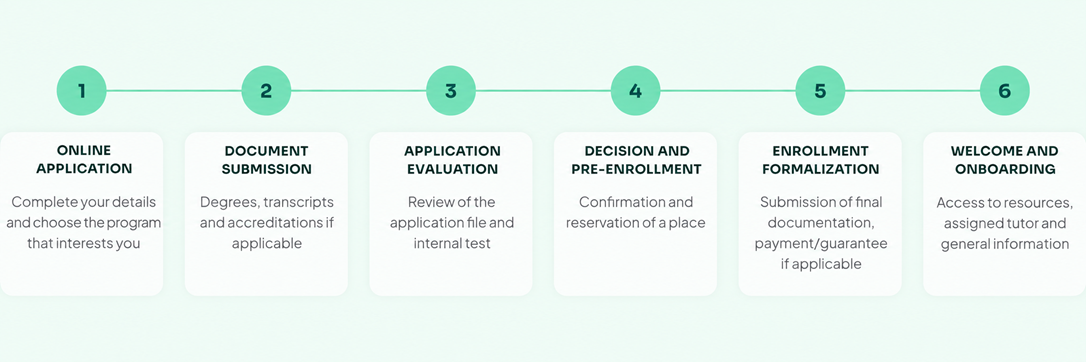
Entry Requirements and Required Documentation
To enrol in the Bachelor’s Degree in Computer Engineering, students must meet the requirements established by current regulations and submit the necessary documentation. The admission requirements for each entry route are outlined below:
Valid Academic Entry Qualification
A Baccalaureate (Bachillerato) qualification, an Advanced Vocational Training (Higher VET) qualification, or another officially recognised qualification granting access to university.
Official Academic Transcript
A complete academic transcript detailing the subjects studied, grades obtained, and successful completion of previous studies.
Identification Document
A valid national identity card (DNI) or passport and, where applicable, an official recognition (homologation) decision or certified translation of foreign academic qualifications.
Language Proficiency Certificate
A recognised certificate demonstrating the required language proficiency level, where this is a specific requirement of the degree programme.
Additional Documentation
Additional requirements arising from agreements, work placements, mobility programmes, or other specific academic circumstances.
Regulations and Accreditations
The Bachelor’s Degree in Computer Engineering is governed by the current regulations applicable to official university qualifications in Spain, ensuring its academic quality, scientific rigour and official recognition.
The organisation, verification and accreditation of official study programmes are carried out in accordance with the requirements established by Royal Decree 822/2021 of 28 September, which regulates the structure of official university education and the quality assurance procedures across the Spanish university system.
Official degree programmes must undergo verification before they are launched and must be registered in the Register of Universities, Centres and Degrees (RUCT) of the Spanish Ministry of Universities, ensuring their validity and recognition throughout Spain.
Official Links
Would you like to know more?
Download the Complete Study Plan
Access detailed information about the subjects, competencies, ECTS credits and year-by-year structure of UNINDE’s Bachelor’s Degree in Computer Engineering.
This study plan will help you understand what you will study at each stage of the degree and how theoretical and practical content is integrated throughout the programme.
Contact the Student Guidance Team
Do you have any questions about admission requirements, enrolment, work placements or career opportunities for the Bachelor’s Degree in Computer Engineering?
Our Student Guidance Team is here to answer your questions, explain the application process and help you prepare your application.
Request further information and we’ll be happy to assist you with any queries you may have.
FAQs
We have brought together answers to the most frequently asked questions about UNINDE to help you find the information you need quickly and easily.
If you cannot find the answer to your question or need further details, our team will be delighted to help. Simply get in touch and we will get back to you as soon as possible.
Do I need to know how to code before starting the degree?
You do not need to be an expert in programming or mathematics before starting the degree, as the programme provides a solid, progressive foundation in the fundamentals of computing, including algorithms, data structures, networks and security.
What is the difference between Computer Engineering and other technology-related degrees?
Computer Engineering provides broader and more versatile training, covering networks, programming, systems, security and data. This differs from more specialised degrees, which focus exclusively on a single area, such as software development or data science.
Does this degree prepare students for careers in artificial intelligence or Big Data?
Yes. The Computer Engineering degree includes training in areas such as Big Data and machine learning, preparing graduates to work with large volumes of data in applications involving artificial intelligence, automation and predictive analytics.
Are there career opportunities in sectors other than technology companies?
Yes. Computer engineers are also in demand in sectors such as banking, healthcare, logistics, education, public administration and consultancy, due to the increasing digitalisation of business processes.
What is the difference between specialising in Cybersecurity and Data Analytics?
Cybersecurity prepares you to protect systems against digital threats and attacks, while Data Analytics enables you to interpret and extract value from large volumes of data to improve business decision-making.
What technology-related career paths can I pursue after completing this degree?
After completing the degree, you can work as a systems analyst, network administrator, technology innovation specialist, IT consultant, or mobile and web application developer.